
New Haven Warrant Checks
New Haven posts no criminal warrant portal of its own. The New Haven Police Department page gives local contact details, while the Sheriff division answers active-status questions. MyCase and the Clerk supply the court side. A vendor listing is only a lead, and a blank search does not clear you.
- Write down the full name, case or citation number, and court named on any notice.
- Use the sheriff-linked Allen County interface for a public first check and note its update date.
- Search MyCase by case number, citation number, or party name for the public docket.
- Call the Warrant Division at (260) 449-7636 for current status and surrender instructions.
- Ask the Allen County Clerk at (260) 449-7245 about the court file, then seek legal advice before appearing.
Call NHPD Records at (260) 748-7083 only when you need a city police report, not a warrant certification. Spelling, suffixes, middle names, and aliases all change search results in New Haven. Keep a copy of what you searched so the office can trace it later.
New Haven Police Record Routes
NHPD sits at 815 Lincoln Highway East, New Haven, Indiana 46774, with a non-emergency line at (260) 748-7080. The department keeps what its officers create. Circuit and Superior Court files live with the Allen County Clerk, and the Sheriff runs the county public warrant channel. Ask the right office. A report request is not a warrant check. The official NHPD contact screen lists the city office, its records route, and the non-emergency number.
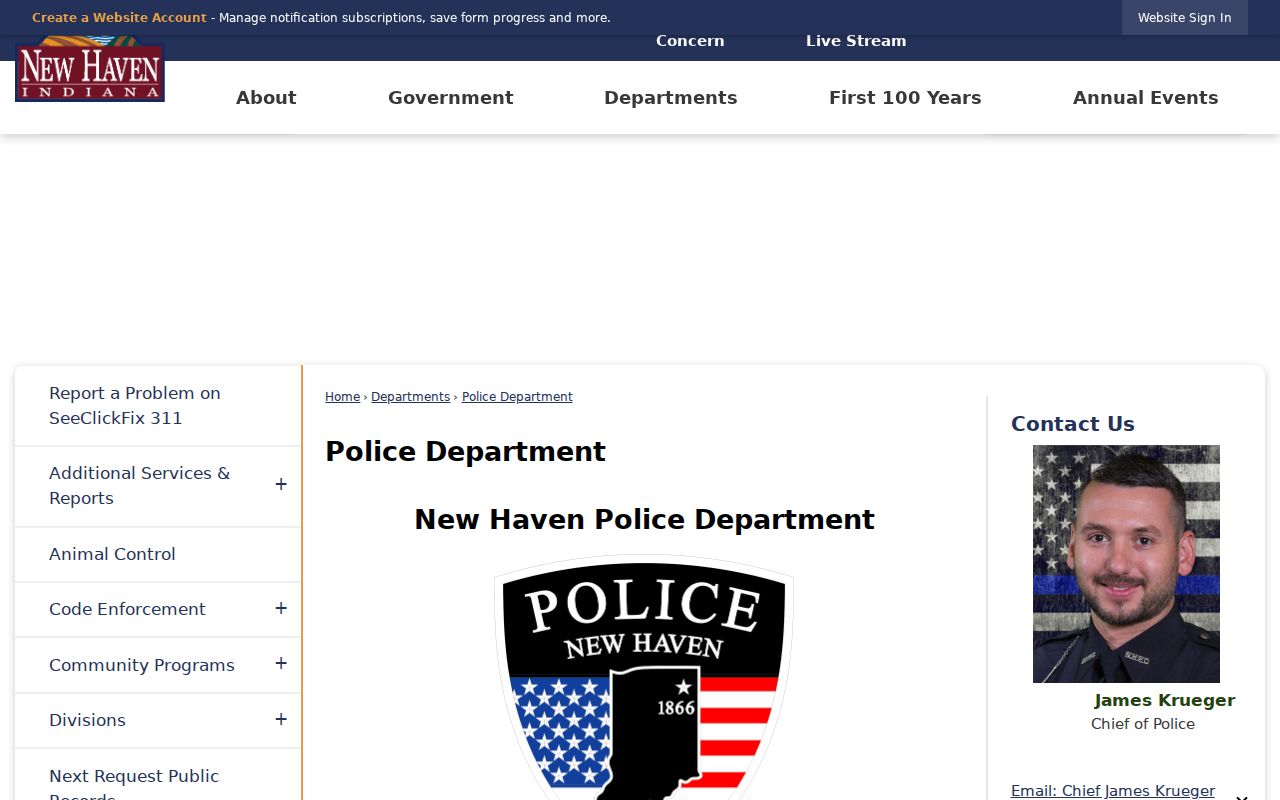
That page points a New Haven resident to the police channel without pretending it is a city warrant list. If a report led to charges, get its number first. Then use the court case number for anything the court must answer.
Policing and Courts in New Haven
NHPD investigates, arrests, and serves process inside the city. It runs no criminal court. Allen Circuit Court and the Allen Superior Courts issue and manage trial-court process, with the elected Allen County Clerk keeping those records. Traffic and misdemeanor matters go to the Allen Superior Misdemeanor & Traffic Division. New Haven cases land there, not at a city tribunal.
New Haven Police
815 Lincoln Highway East
New Haven, IN 46774
Records: (260) 748-7083
Use for NHPD incident and police-record questions.
Allen County Court Record
Allen County Clerk
715 South Calhoun Street, Room 200A
(260) 449-7245
Use for the official Circuit or Superior Court file.
The department advertises 24-hour police availability plus separate administrative hours. Those contacts serve local police records, nothing more. A judge or magistrate issues a warrant, the county court record controls its legal status, and authorized city or county officers may serve it.
New Haven City Court Ended
This court closure is the single most important fact for any New Haven warrant question. The police department still runs, and its public records contacts still work. None of that adds up to a working municipal criminal court. The official Indiana Odyssey court list marks Allen/New Haven City Court as abolished effective December 31, 2018, and that date settles where a case belongs now. So when an old New Haven reference turns up, grab the citation or cause number first. Then ask the Allen County Clerk where the matter was transferred or filed. Older city code pages and FAQs still name the former court, quote deferral totals from that era, and point people to an office that no longer acts as a criminal court. Treat those remnants as history, not as a current tribunal or payment path. Searching MyCase and asking the Clerk which Allen Superior Court division controls the case keeps a resident away from a court that no longer exists. Verify anything legacy before following a fee or appearance instruction. A city office can explain its own services today, but it cannot revive, recall, or certify a warrant the county trial courts issued.
Warrants in New Haven: The Main Types
The wording on a New Haven record tells you which office to call next. Local public records favor the terms “bench warrant” and “failure to appear”; capias is not the label you will usually see. Also know that civil body attachments and tax warrants sit apart from criminal warrants entirely.
| Process | How It Arises | Best Confirmation |
|---|---|---|
| Arrest warrant | A judge authorizes arrest after a probable-cause request. | Issuing court and Sheriff |
| Bench warrant | A court responds to a missed date or noncompliance. | MyCase, Clerk, Sheriff |
| Probation or parole warrant | A supervision authority reports an alleged violation. | Supervision office |
| Family process | An order arises in a family case. | Superior Court division |
| Body attachment | Civil contempt brings a person before court. | Clerk and civil process |
A search warrant in New Haven lets police search, not a way to look up a person's status. And an Indiana Department of Revenue tax warrant is a collection record, not a criminal arrest warrant.
New Haven Legacy Citation Trap
New Haven’s legacy FAQ still points readers to an infraction-deferral route through New Haven City Court and quotes old totals of $192.50 or $252.50, but the court’s abolition makes those directions unsafe to treat as current. Do not mail funds, lean on an outdated due-date process, or assume an old city reference names today’s court. Start instead with New Haven Police, who can identify the citation or provide a related report. Then verify the active case with the Allen County Clerk and Allen Superior Misdemeanor & Traffic Court, since payment must match the right case. Hold onto the receipt, but remember it does not by itself show that a failure-to-appear warrant was recalled or that the Indiana BMV received the court’s update. Fees, eligibility, hearings, and disposition all need direct confirmation. For the court-focused route, see Allen County traffic warrants.
New Haven Warrant Records: What They Show
A solid New Haven warrant lookup starts with case numbers and court identifiers, not with names pulled off a live listing. MyCase can show a chronological case summary along with public dates, status, and some orders. Even so, the public display may omit restricted material or lag behind what an operational warrant check returns.
| Case number | A court identifier such as 02D05-2609-CM-000000; verify the real number. |
|---|---|
| Warrant type | Arrest, bench, probation, parole, family, or civil attachment. |
| Issuing court | The Allen Circuit or Superior Court division controlling the case. |
| Public date | An issue, hearing, or docket date when open to inspection. |
| Status | Active, served, recalled, or another custodian-confirmed state. |
| Bond instruction | A case-specific amount or method, if public and current. |
An old image of a New Haven warrant record will not settle a status or bond question. The issuing court and the Warrant Division can say which record controls now.
New Haven Records Appointments
New Haven's Additional Services and Reports page covers daily activity logs, how citations get routed, and appointments for records. For that work, the city lists (260) 748-7083, or the main police number, (260) 748-7080. Administrative desks keep Monday through Friday hours, 8:00 a.m. to 5:00 p.m., and close from noon to 1:00; police themselves are on duty around the clock. Remember what an appointment is. It concerns a police record held by New Haven Police, not a sitting with a judge, and it cannot certify active warrant status. When you ask for a report, bring the incident or citation number, the date, the location, and a focused description of what you need. If the request turns on a court order, take it to the Clerk instead. If it turns on a live county warrant, go to the Sheriff Warrant Division. That boundary is one of the most useful safeguards in any New Haven records search.
New Haven Warrants and Allen County
New Haven police work feeds into a county court system. An NHPD investigation may prompt a judicial request, an Allen court may issue process, and authorized officers may serve it. Indiana has no public statewide criminal-warrant search. MyCase is a case-information service, while IDACS and NCIC are law-enforcement systems. For the broader route, see Allen County warrant records.
Warrant flow: New Haven Police investigation › Allen Circuit or Superior Court process › Sheriff or authorized police service › law-enforcement systems
A city police report, a MyCase docket, and a sheriff-linked result each answer a different question in New Haven. Use the agency that owns the record, and ask it to verify the current state.
New Haven Records Versus Status
A daily activity log may show only that police responded to a call. An incident report may describe what an officer recorded in New Haven. Neither one substitutes for the current court docket or Sheriff verification of a warrant. In the other direction, a warrant result does not automatically open a police investigative file. Every source has its own purpose and its own access limits.
Match the question to the custodian. Ask New Haven Police for its report, the Clerk for the court file, and the Warrant Division for live active status.
This three-part route also guards against stale legacy pages in New Haven. Keep the case or citation number, the date of each inquiry, and the office you contacted. When two sources conflict, ask the issuing court and the Sheriff which status controls. Never publish names, home addresses, dates of birth, photographs, or charge cards taken from a live warrant interface.
Accessing New Haven Warrant Records
New Haven police records, Sheriff records, and court records sit with different custodians. The Indiana Access to Public Records Act governs agency records, while Indiana court-access rules govern judicial records. A police request goes to NHPD when NHPD created the report. Court documents belong with the Clerk. Sheriff-held non-exempt records use the Sheriff records route.
Key rules:
Indiana Access to Public Records Act sets the public-agency access policy, subject to exemptions.
Indiana Court Records Rule 4 states the court-record access baseline.
Rule 5 protects sealed, juvenile, investigative, and some temporary arrest-warrant material.
A withheld record can reflect a lawful restriction rather than the absence of a warrant. Online data is not the official New Haven court record.
Resolving a New Haven Warrant
Start with the New Haven document that raised the concern. A police report number belongs with NHPD, while a citation or case number points toward the Clerk and Allen Superior Court. Keeping those identifiers apart helps staff find the right record without treating a police appointment as a court hearing or a warrant recall. Next, confirm the issuing court, the case number, the warrant type, and its current status. An attorney may contact the court or arrange the appropriate formal step. If the Sheriff instructs a person to surrender, the published route is Door #21 with photo identification. Cash or surety bond may be accepted when authorized, though release is never promised.
- Confirm the case with the Warrant Division and Clerk.
- Ask whether counsel, a hearing, surrender, or bond is next.
- Bring identification and plan for custody if directed to appear.
- After an order or payment, obtain confirmation of recall or disposition.
- Keep the order, receipt, next date, and office contact.
Bond is not dismissal. Payment is not automatic recall. A missed new date can spawn more court process. Ask which Allen Superior Court division now holds any case that began under an old New Haven reference. If a traffic nonappearance led to an Indiana BMV suspension, confirm the court sent its appearance or disposition notice, then check the state record. A police report appointment cannot do either step. Keep New Haven Police, the Clerk, the Sheriff, and BMV confirmations separate so each record can be traced.