
Huntertown Warrant Checks
Huntertown has no police department of its own, no municipal criminal court, and no town warrant portal. The Allen County Sheriff covers the town by contract and is the office to call on active status. MyCase gives public court context, while the Allen County Clerk keeps the official Circuit and Superior Court files. A vendor result is a lead, not a certificate.
- Record the name, case or citation number, and court shown on any notice.
- Check the sheriff-linked county interface and note its update date.
- Search MyCase by case number, citation number, or party name.
- Call the Warrant Division at (260) 449-7636 to confirm status and next steps.
- Ask the Clerk at (260) 449-7245 about the court file, then seek counsel before appearing.
Town Hall cannot certify a criminal warrant for Huntertown. Watch spelling, suffixes, and aliases when running a name search. Save the source and the date so an official office can reconcile what an online display shows.
Huntertown Warrant Town Hall Boundary
Huntertown Town Hall sits at 15617 Lima Road, Huntertown, Indiana 46748, and the town phone is (260) 637-5058. It handles municipal administration. No public hours are posted, so call before you count on a visit. Staff there can help with town services, but they do not keep Allen criminal case files. The official Huntertown municipal screen lays out the town's civic contacts.
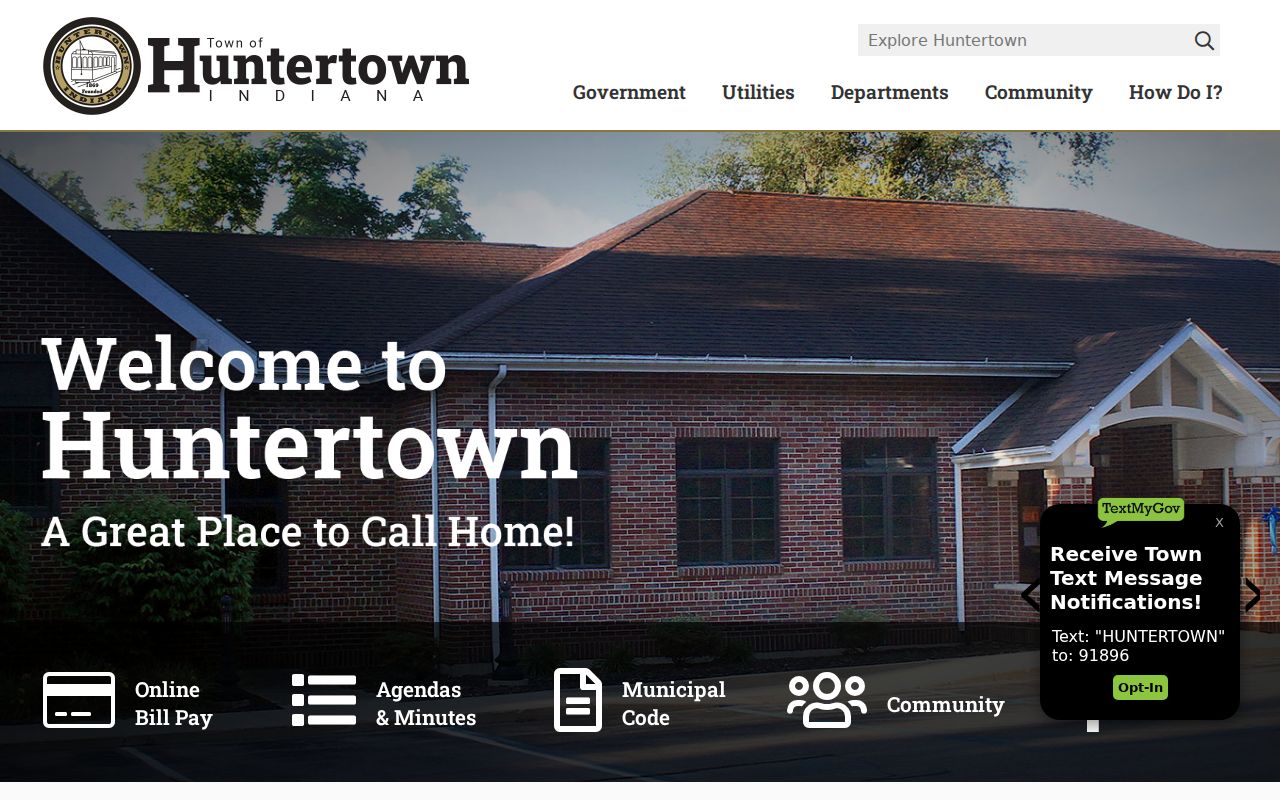
That page is for civic orientation only. It offers no Huntertown warrant search, no police desk, and no municipal criminal court. A deputy's report belongs on the Sheriff route; a court order belongs with the Clerk.
Huntertown Warrant Policing and Courts
Huntertown gets its police coverage from the Allen County Sheriff under a contract, in place of a town department. A Community Resource Officer links county law enforcement with the town. Allen Circuit Court and the Allen Superior Courts issue the process. The Allen County Clerk keeps the official records.
Allen County Sheriff
Contract police coverage in Huntertown
Warrants: (260) 449-7636
Use for active status and Sheriff-created records.
Allen County Clerk
715 South Calhoun Street, Room 200A
Fort Wayne, IN 46802
(260) 449-7245
Use for the official court file.
A budget line for police protection does not create an independent Huntertown agency. A judge issues the warrant, and deputies or other authorized officers serve it.
Huntertown Warrant Contract Coverage
The contract model clears up a common point of confusion for Huntertown residents. A deputy assigned to town concerns still works for the Allen County Sheriff, so reports, active-status checks, and operational questions all stay with that county agency. Town Hall at 15617 Lima Road is a civic contact, not a police records bureau or a criminal court. Nobody needs to hunt for a Huntertown warrant desk, because none exists. Ask the Warrant Division for current status, Sheriff Records for a deputy-created report, and the Clerk for the judicial file. The town's police-protection budget line does not change that custody. If you are directed to appear or surrender, ask the responsible county office for the current entrance, identification needs, and case-specific instructions before you travel.
Warrants in Huntertown: The Main Types
The label on a Huntertown record tells you which office can answer the next question. Local sources say "bench warrant" and "failure to appear" rather than capias. Civil body attachments and tax warrants are separate animals from criminal warrants.
| Process | How It Arises | Best Confirmation |
|---|---|---|
| Arrest warrant | A judge authorizes arrest after a probable-cause request. | Issuing court and Sheriff |
| Bench warrant | A court responds to a missed date or noncompliance. | MyCase, Clerk, Sheriff |
| Probation or parole warrant | A supervision authority reports an alleged violation. | Supervision office |
| Family process | An order arises in a family case. | Superior Court division |
| Body attachment | Civil contempt brings a person before court. | Clerk and civil process |
In Huntertown, a search warrant authorizes a search of property, not a public person-status lookup. An Indiana Department of Revenue tax warrant is a collection record, not a criminal arrest warrant.
Huntertown Traffic Case Routing
A Huntertown address does not create a town criminal docket. For a traffic or ordinance issue, find the court printed on the citation and search by citation or case number. Allen Superior Misdemeanor & Traffic Court handles county traffic and infraction work. The Clerk can confirm which court holds the file and whether a missed date produced court process. Payment and recall are separate questions. A receipt does not prove a bench warrant was withdrawn or that Indiana BMV received a court disposition. Ask the Clerk what order was entered, whether an appearance is required, and how an update reaches BMV. Town Hall may point you to a local administrative code contact, but it posts no current hours or ordinance-citation routing, so lean on the citation and the county custodian rather than assuming Huntertown has its own court. See Allen County traffic warrants for more court detail.
Huntertown Warrant Records: What They Show
A safe Huntertown warrant review starts with court and case identifiers, not personal details copied off a live listing. MyCase may offer a chronological case summary, public dates, status, and some orders. A public display can still omit restricted material or lag behind an operational check.
| Case number | A court identifier such as 02D05-2609-CM-000000; verify the real number. |
|---|---|
| Warrant type | Arrest, bench, probation, parole, family, or civil attachment. |
| Issuing court | The Allen Circuit or Superior Court division controlling the case. |
| Public date | An issue, hearing, or docket date when open to inspection. |
| Status | Active, served, recalled, or another custodian-confirmed state. |
| Bond instruction | A case-specific amount or method, if public and current. |
An old image of a Huntertown record can mislead on status or bond. The issuing court and the Warrant Division can tell you which record controls now.
Huntertown Growth and County Service
Huntertown is a town, not a city. Its 2020 Census population was 9,141, third among the five Allen County incorporated places. That count says nothing about crime or warrants. It explains why Huntertown buys sheriff coverage instead of building its own department and records system. For a resident of Huntertown, the contract keeps recordkeeping easy to map. There is no town police archive between Town Hall and the Sheriff. A deputy's incident report stays with the Sheriff. The resulting judicial order moves through the Clerk. Note both the incident number and the court case number, and each office can find its own piece of one event. The chain in Huntertown is short. The Sheriff supplies local police service and current warrant confirmation. MyCase offers public case orientation. The Clerk keeps the official trial-court record. Town Hall handles municipal administration. Huntertown has no warrant office of its own, whatever growth or a police-protection budget might suggest. The contract stays county law enforcement, even when a deputy works close to Huntertown concerns.
Huntertown Warrants and Allen County
Huntertown already sits inside a county policing and court chain. A contracted deputy may investigate. An Allen court may issue process, and the Sheriff or another authorized officer may serve it. Indiana has no public statewide criminal-warrant search. MyCase is a case-information service, and IDACS and NCIC are restricted law-enforcement systems, so see Allen County warrant records for the full county route.
Warrant flow: Sheriff contract policing in Huntertown › Allen Circuit or Superior Court process › Sheriff service and operational systems
Each record answers a different question. A Huntertown resident comparing a sheriff report, a MyCase docket, and a warrant result should ask which office owns the latest status.
Huntertown Custodian Mistakes
The most common mistake in Huntertown is asking Town Hall to certify a criminal record. A second treats the Sheriff's public vendor interface as complete. A third reads a budget line as proof of an independent police department, though no such department exists. Each error blurs a real boundary in Huntertown.
Use the correct custodian. Town Hall handles town administration, the Sheriff handles contract policing and active status, and the Clerk controls court files.
A zero web result can mean spelling or timing. It cannot prove no process exists. A hit still needs identity and status confirmation. Huntertown residents should never approach anyone in a result or publish a photograph, address, date of birth, or charge card. A Huntertown resident checking an own warrant should use the Warrant Division rather than a public tip channel.
Accessing Huntertown Warrant Records
Huntertown records sit with different custodians. Police reports go to the Allen County Sheriff when the Sheriff created them. Court documents go to the Clerk. Non-exempt Sheriff records use the Sheriff records route. The Indiana Access to Public Records Act governs agency records, while Indiana court-access rules govern judicial ones. A focused Huntertown request should give a description, date range, location, involved party, and incident number when known. That differs from a warrant-status check. Current investigations, juvenile files, protected personal details, confidential-informant material, and safety-sensitive Huntertown records may be withheld. A denial or delay does not mean the court process never existed in Huntertown.
Key rules:
Indiana Access to Public Records Act sets the public-agency access policy, subject to exemptions.
Indiana Court Records Rule 4 states the court-record access baseline.
Rule 5 protects sealed, juvenile, investigative, and some temporary arrest-warrant material.
A withheld record can reflect a lawful restriction, not a missing warrant. Online data is not the official Huntertown court record.
Resolving a Huntertown Warrant
Start with the basics. Confirm the issuing court, case number, warrant type, and current status for the Huntertown case. An attorney can contact the court or arrange the proper formal step. If the Sheriff directs a Huntertown resident to surrender, the published route is Door #21 with photo identification, and cash or surety bond may be accepted when authorized, though release is not promised.
- Confirm the case with the Warrant Division and Clerk.
- Ask whether counsel, a hearing, surrender, or bond is next.
- Bring identification and plan for custody if directed to appear.
- After an order or payment, obtain confirmation of recall or disposition.
- Keep the order, receipt, next date, and office contact.
Bond is not dismissal. Payment does not recall a warrant automatically. A missed Huntertown court date can create more process. Different warrant types also lead to different offices. A Huntertown probation or parole warrant may require the supervising authority. A family matter belongs with its Allen Superior division. A civil body attachment goes to the Clerk and civil process staff rather than a criminal charge, and tax warrants use the Indiana Department of Revenue route, so sorting the type first keeps any Huntertown resident from completing the wrong step.