
How Bench Warrants Work in Allen County
Allen County public materials use the terms bench warrant and failure to appear. A bench warrant is a judge's response to a missed hearing or another failure to comply in an existing case. It differs from a probable-cause arrest warrant that begins with an alleged offense. Only the issuing court can explain the basis and the next step in one case.
The Allen County Sheriff Warrants & Fugitive Division handles adult criminal bench warrants as well as probation, parole, family court, and small-claims processes. These categories should not be blurred. A civil body attachment can result from contempt in a small-claims matter, but it is not a new criminal charge. Likewise, a docket entry showing a missed date is not itself a certified statement that a warrant remains active.
Allen County Docket and Sheriff Check
Start with Indiana MyCase when a case number is known. That identifier is more reliable than a common name. Otherwise, use party search with a last name plus a first name, middle name, or date of birth, then narrow the court to Allen. Review the case type, chronology, hearing dates, orders, and current public status.
MyCase is not a complete warrant index or the official court record. A status label may describe the case rather than a live warrant. Next, call the Allen County Warrant Division at (260) 449-7636. Ask whether the bench warrant is active or recalled, which court issued it, and what case number controls. The Clerk can then provide docket help or a public copy from the official file.
Note: A public docket event gives case context, while the Sheriff and issuing court confirm current bench warrant status.
Allen County Bench Warrant Process
A court first sets a hearing, payment, supervision term, or other obligation in a pending case. If the required act is missed, a judge may issue a bench warrant. The order authorizes law enforcement to take the person into custody and bring the matter back before the court. The court record may show the missed setting and later order, though access can vary.
Allen Circuit Court and Allen Superior Courts form Indiana Judicial District 7. Their divisions handle criminal, traffic, family, small-claims, and related work. The elected Clerk of the Allen Circuit and Superior Courts maintains those files and records court process. Indiana has no single public statewide criminal-warrant search. IDACS and NCIC are police systems, while MyCase is only a public case-information service.
Missed Allen County Court Dates
If a court date was missed, collect the case number, court name, hearing date, and any notice first. Check the latest chronology in MyCase, then call the Warrant Division privately. Ask which office controls the status. Contact the Clerk or counsel about a formal motion, hearing, or required appearance rather than trying to speak privately with the judge.
Indiana judicial conduct rules prevent a judge from privately discussing a pending case with one party. The Clerk can explain filing routes and provide records, but cannot promise that a warrant will be recalled. A lawyer can ask the court about a motion and help plan for bond, booking, or another hold. If the matter is tied to probation, include the supervising office because its warrant and release issues may differ.
How Bench and Arrest Warrants Differ
Both orders can authorize custody, but their starting points are distinct. An Allen County bench warrant usually grows from an existing case and a missed duty. An arrest warrant begins with a probable-cause request reviewed by a judge or magistrate. A summons directs someone to appear without authorizing the same immediate arrest.
| Feature | Bench Warrant | Arrest Warrant |
|---|---|---|
| Trigger | Missed setting or noncompliance | Probable cause of an offense |
| Review | Judge in an existing matter | Judge or magistrate reviews a request |
| Context | Existing court, probation, or civil process | Investigation or criminal filing |
| Resolution | Appearance, recall, or court order | Service, booking, bond, and hearing |
Allen County Civil Attachments
A small-claims body attachment is civil court process and should not be labeled as a criminal bench warrant. Allen County Clerk forms identify fields such as the case number, person in contempt, hearing, judge or magistrate, bond or escrow, expiration, Clerk certification, and Sheriff's return. The distinction affects which division has the file and what question to ask.
The civil route may involve Small Claims or Family staff and the Sheriff's Civil Division. Ask for the writ type, hearing, expiration, service return, and any bond or escrow terms. Do not infer a criminal charge from the word warrant on a civil information card. The issuing court's current order controls, especially where an older blank form and newer local rule may not use the same timing language.
Clearing a Bench Warrant in Allen County
Resolution begins with verified facts, not a payment made at random. Confirm the warrant, case, and issuing division. Ask counsel whether a motion to recall, a new hearing, or planned surrender is appropriate. A recall means the judge withdraws the warrant. It is not complete until the court has entered the order and current status is confirmed.
- Confirm active status and obtain the case number from the Sheriff.
- Review the docket and identify the Allen County court division.
- Ask counsel or the Clerk about the formal motion or hearing route.
- Follow the court's appearance, surrender, bond, and follow-up instructions.
Caution: Do not assume a payment, old docket entry, or missing online result means an Allen County bench warrant was recalled.
Allen County Surrender and Payment
If the Sheriff directs surrender, the published location is Allen County Lockup Door #21 on the north side of Superior Street between Calhoun and Clinton. Bring photo identification and confirm current hours. The Sheriff's page says bail may be posted by cash or surety bond. Voluntary surrender does not promise release because the court may address bond, other holds, or a required hearing.
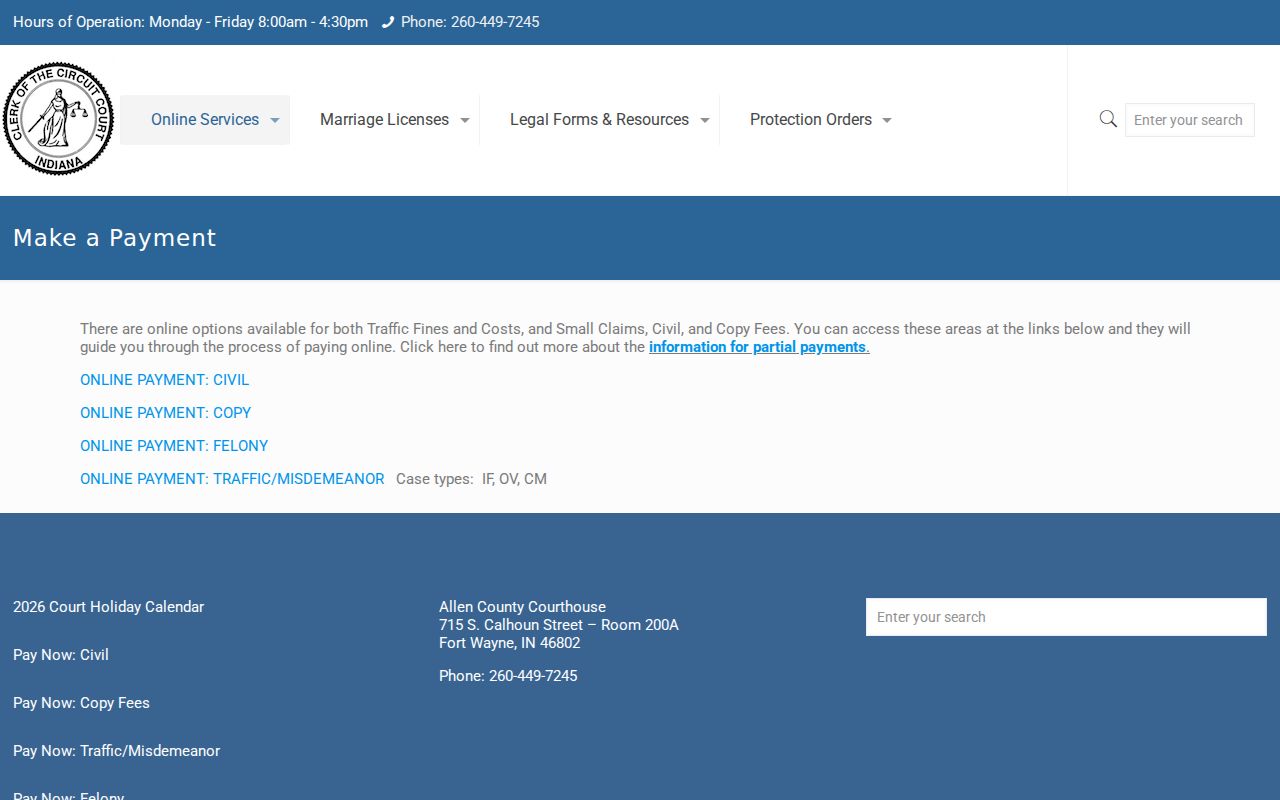
The Clerk's official payment page lists felony, misdemeanor and traffic, civil, small-claims, and copy-fee categories. It is a payment route, not proof of recall. The official screen below shows those categories without displaying account information.
Use the correct case number, keep the receipt, and obtain an order or direct confirmation that the warrant status changed.
After an Allen County Bench Warrant
Keep a simple resolution file after the court event. It should contain the case number, issuing division, court order or receipt, confirmed current status, release conditions, and next hearing date. If probation is involved, verify that the supervising office received the update. When a traffic failure to appear is involved, ask whether the court notified the Indiana BMV of the appearance or disposition.
A cleared court issue and a driving-privilege hold are separate matters. The BMV says court notification starts the restoration process, and its online driver record can show a remaining administrative consequence. A receipt by itself does not prove that the court recalled a bench warrant or that another agency updated its system. Confirm each linked status with the office that maintains it.
Note: Final proof comes from the court order and current custodian confirmation, not from an old or missing web result.
Allen County Courts That Issue Bench Warrants
The case may belong to Allen Circuit Court or one of nine Allen Superior Court divisions. The division matters because the Sheriff serves the order, but the issuing judge controls recall. Allen/New Haven City Court was abolished in 2018, and the official Indiana court list reviewed shows no current standalone municipal criminal court or justice-of-the-peace court in Allen County.
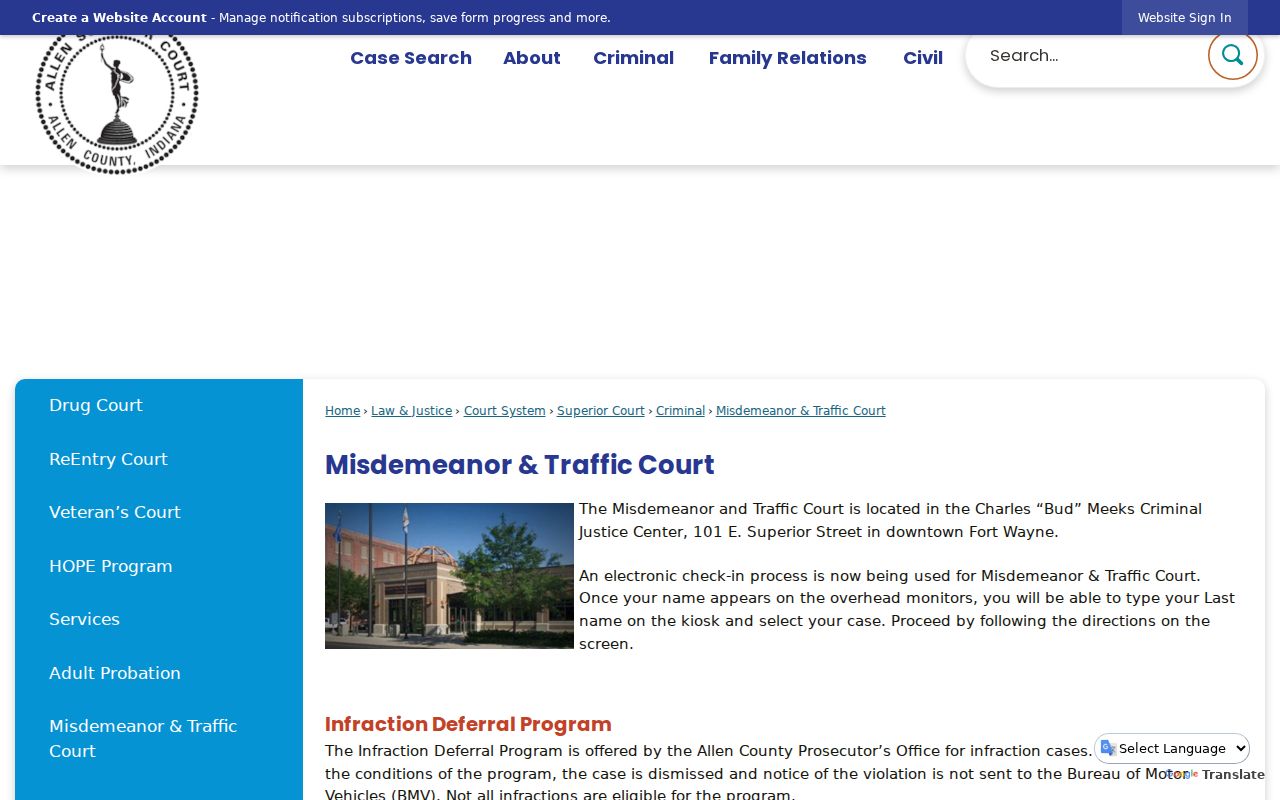
Traffic and misdemeanor matters route through the Allen Superior Misdemeanor & Traffic Court. The official Bud Meeks Criminal Justice Center page describes the court and its electronic check-in process. This image shows that civic access information.
The kiosk is an arrival tool, not a warrant search. For any division, match the court name and case number, then verify the current order through the Clerk, attorney, and Warrant Division.